
Does Your Business Really Need a Website?
How to choose a minisite, a full website or a custom system based on your business needs
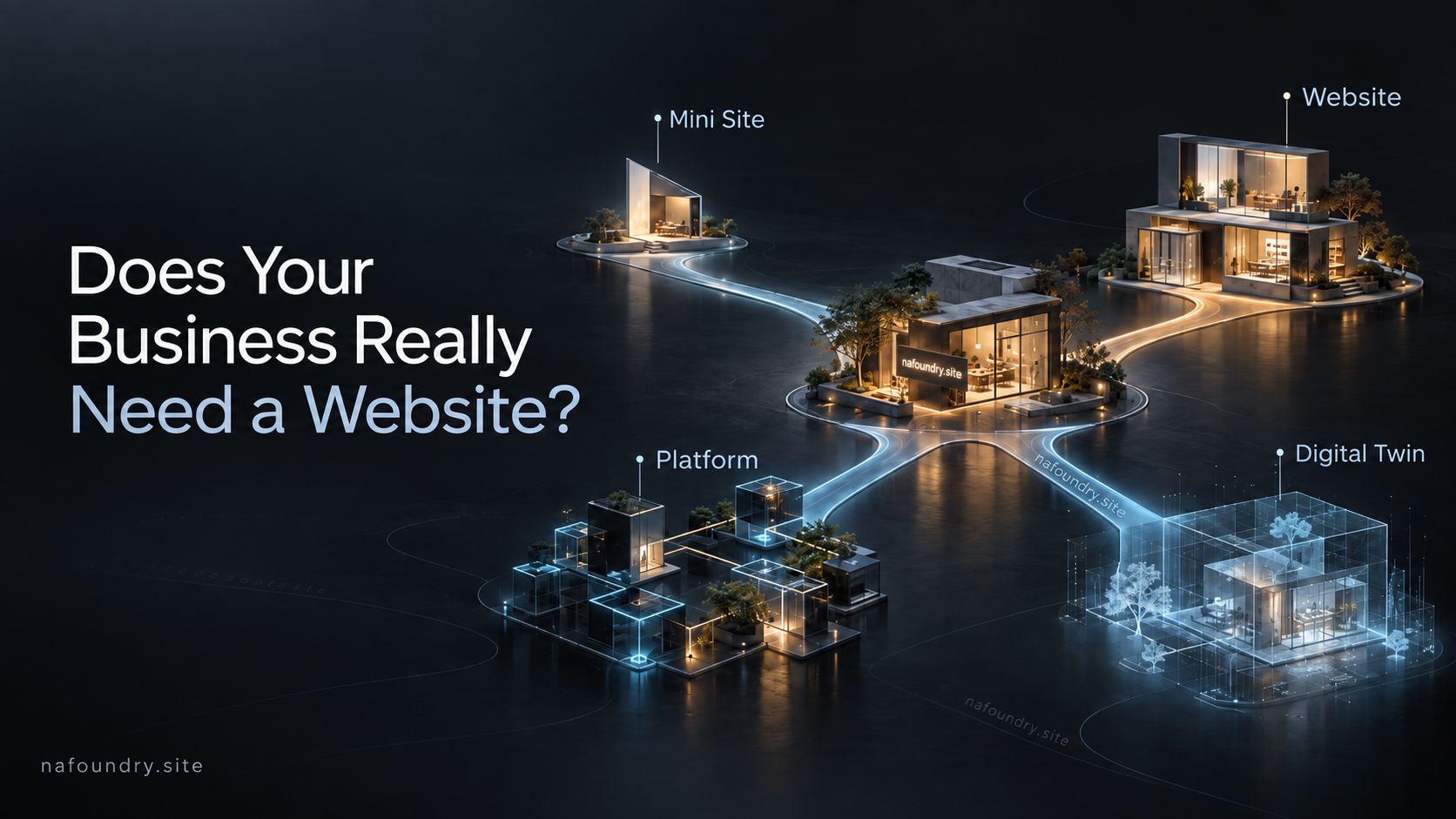
When someone says, “Every business needs a website,” your first question might be: why?
A website can be a sensible investment when your current tools make it difficult to explain your services, attract customers, take orders or manage enquiries. But if you are still testing an idea, or your existing tools meet your needs, a smaller first step may be enough.
You might already be active on Instagram, talk to customers on WhatsApp and receive most of your sales through referrals. In that situation, building a website is not necessarily your first priority.
At NA Foundry, we start with a question:
“What does your business need to do online?”
Sometimes the answer is a full website. Sometimes a small, focused site is enough. You may need a custom system, or you may be better off putting your budget towards a more pressing problem for now.
When does building a website make sense?
A website creates value when it has a clear job to do. For example:
Customers search for you and your services before buying.
You repeatedly explain products, services or terms in private messages.
Your business information is scattered, making answers difficult to find.
Orders or enquiries get lost across different conversations.
You need an organised portfolio, an enquiry form or appointment booking.
You want to develop a plan for reaching people through Google Search.
Part of your sales or service delivery needs to happen online.
Even then, you may not need a complex website. Its size and features should match the problem it needs to solve.
An independent professional might need a service overview and an enquiry form. A shop may need a catalogue and a way to place orders. A service company might need a system for submitting and tracking requests.
When might you not need a website yet?
Imagine that you have just started a business and have not yet settled on your main product, audience or sales approach. Building a large website at this stage could mean committing to a solution before you understand the need.
If you are still validating the idea, assessing demand or working out how to source products and find customers, those issues may deserve attention first.
Being new is not, by itself, a reason to avoid a website. A simple page can help introduce an offer or test interest. The decision depends on your goal, budget and how you plan to test the idea.
A website does not generate customers or sales simply by existing. Content, customer acquisition, service quality and the way you handle enquiries all contribute to the result.
Define the problem before choosing the technology
Website conversations often begin with questions such as:
“Should we use WordPress or React?”
“How many pages do we need?”
“Which template should we choose?”
These questions matter, but first we need to know what the digital product is meant to do.
Should visitors learn about your services, view your work, request a consultation, buy a product, book an appointment or track a request after submitting it?
Those answers determine the structure and features. Then we can make informed decisions about the technology, delivery time and cost.
Nahid’s approach: I do not start with a page count
When someone says, “I need a five-page website,” I still do not have enough information about their needs. A page count does not describe the customer journey or the problem the business faces.
I prefer to understand:
What product or service does the business offer?
How do customers find it today?
What should they do next?
Where does the process waste time or lose enquiries?
Sometimes that discussion shows that a small site is enough. Sometimes a campaign needs a dedicated landing page. In other cases, we need to design a system for part of the business’s day-to-day work.
Four different needs, four different solutions
These are not mandatory stages of growth. A business does not have to start with a small site and eventually become a platform. A simple solution may meet your needs for years.
1. A simple, professional online presence
If your goal is to introduce the business and make contact easier, a small, focused website may be enough.
A minisite is a small website built around a specific purpose, with limited content: an introduction, services, selected work and contact details, for example.
If you only need a brief introduction and contact information, a digital business card can also be a starting point. It generally offers less content and fewer features than a minisite.
2. A website that helps visitors become customers
Sometimes visitors need to compare services, view examples, find answers and send an enquiry.
Here, content structure, speed, user experience, search optimisation and the contact process become more important.
Visitors need enough information to take a useful next step. Reaching people through Google also takes relevant content and ongoing work; launching a website does not guarantee search traffic.
3. A website that supports daily operations
A training provider may need enrolment, payment and access to learning materials. A service company may want customers to submit requests and check their progress.
The website now becomes part of the everyday business process. Alongside the page design, we need to consider data, permissions, errors and how requests will be managed.
4. A digital platform
When several user groups, different roles, dashboards and connected processes are involved, you may need a digital platform.
A system where customers, service providers and administrators each have different responsibilities and access rights needs carefully designed workflows.
The distinction between a website and a platform is not the number of pages. It is what the system does and how it connects people, data and processes.
Where do Instagram and messaging apps fit?
A website can work alongside social media. Instagram may help people discover your brand, while WhatsApp makes conversations easier.
A website can provide organised information, explain services and support actions such as submitting an enquiry.
The important point is to define each tool’s role. If all orders arrive through direct messages, do any get missed? Do people have to wait for a reply to understand your buying terms? Would a change in access to a social platform disrupt customer communication?
These questions help you decide how much your business should depend on each channel.
A hypothetical example: a handmade products shop
Suppose you run a small shop with a manageable number of orders. A social page and a minisite introducing the brand, selected products and ordering terms may be enough.
As sales increase, new problems may appear. Explaining stock availability might take more time, manual orders could contain mistakes and customers might repeatedly ask about order progress.
A catalogue, order form, inventory management or order tracking could then be useful. Customer accounts and other features should be added when there is a reason for them; they are not all necessary on day one.
The useful question is:
“Which feature would solve our problem today, and what might we need later?”
Understanding future needs helps with planning. It does not mean building every possible feature from the beginning.
Answer these five questions before building a website
Before discussing design and technology, write down your answers:
Who is my main audience?
What is the most important action I want them to take on the site?
How does that action happen today?
Where does the process waste time or lose customers?
What would need to change if customers or enquiries doubled?
Turn those answers into a goal you can assess: fewer repeated questions, more organised enquiries or easier access to service information, for example.
That goal will help you evaluate whether the solution is useful after it is built.
From an online presence to a “digital counterpart of your business”
At NA Foundry, we use the phrase “digital counterpart of your business” to describe our approach to connecting brand identity, services, customer communication and digital processes.
This should be distinguished from the technical meaning of a Digital Twin. A website or online system does not become a technical digital twin simply because it has users and data.
We will explore that distinction and its relevance to businesses in a separate article.
Frequently asked questions
Do I need a website if I already use Instagram?
It depends on your business needs. If your current tools handle service information and orders well, a website may not be urgent. If information is scattered, answers are repetitive or enquiries are missed, a website could be a useful addition.
Is a minisite enough to get started?
It may be enough to explain services, show selected work and make contact easier. If you need payments, order management or different user permissions, those requirements need a separate assessment.
Will a website increase my sales?
Building a website alone does not guarantee sales. Results depend on reaching the right audience, explaining the offer clearly, making enquiries or purchases straightforward and following up with customers.
What should I prepare before requesting a website?
Define your audience, the action you want them to take, how that happens today and what is difficult about the current process. These details are more useful at the start than a page count or a technology preference.
So, does your business need a website?
The answer depends on what you need it to do.
If an introduction and contact details are enough, a small solution may be appropriate. If visitors need to assess services and place orders or submit enquiries, a website can create value. If several user groups and connected processes are involved, a custom system may be needed.
The right solution solves a specific problem at a proportionate cost and level of complexity.
If you’re unsure which digital solution is right for your business, visit the consultation section at nafoundry.site and tell us how customers currently reach you and which part of the process you find challenging.
At NA Foundry, understanding that problem is where a project begins. Then we decide what needs to be built.
Written by Nahid Abdolahpour | Web Engineer & Custom Digital Solutions Developer